
Stop overpaying. Compare crypto before you buy.
CoinCompare is a simple idea done well: line up the price, the fees and the app from every major exchange side by side, so a single "buy" button never costs you more than it should.
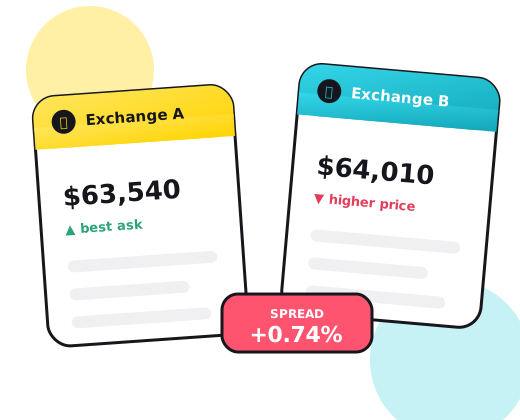
What CoinCompare does
Four questions, answered before you spend a penny
Every crypto purchase comes down to the same four questions. CoinCompare answers all of them in one place instead of leaving you flicking between ten browser tabs.
Where is it cheapest?
Live prices for the same coin across exchanges, so you can see the spread instead of guessing.
See live prices →What are the fees?
Trading, spread and withdrawal fees compared side by side — the costs that quietly eat your returns.
Compare fees →How much will I get?
A calculator that converts any amount between coins and currencies at reference rates in a second.
Open calculator →Which app should I use?
Honest, security-first comparisons of exchanges, wallets and apps — the good and the bad.
Compare apps →The one thing beginners get wrong
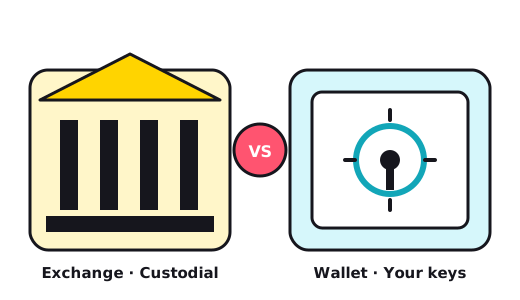
Custodial vs non-custodial — in plain English
An exchange like Binance, Bybit or Kraken is custodial: it holds your coins the way a bank holds your cash. Convenient, but the keys are theirs — and if the platform freezes withdrawals or fails, your coins are caught in it.
A non-custodial wallet such as MetaMask or Trust Wallet is your personal safe. You hold the keys and the 12–24 word seed phrase. There is no "forgot password" button and no support desk that can reset it for you. Lose the phrase, lose the coins.
Rule of thumb: use an exchange to buy, use a wallet you control to hold anything you'd be upset to lose.Compare self-custody wallets
How it works
From "which exchange?" to "bought" in three steps
1. Pick your coin and currency
Choose what you want to buy — Bitcoin, Ethereum, a stablecoin like USDT — and the currency you're paying with. CoinCompare pulls the current market picture across exchanges.
2. Compare price and fees together
A tempting headline price often hides a fat spread or a brutal withdrawal fee. We show the all-in cost, not the marketing number, so the cheapest-looking option isn't a trap.
3. Buy on the exchange you chose
Once you know where you're getting the best deal, head to that platform to place the order. Moving a large amount? Send it to a wallet you control afterwards.
Popular comparisons
Start with what everyone else is comparing
₮ USDT vs $ USDC
Two dollar stablecoins, two very different risk profiles. Which one actually stays at $1 when markets panic?
Read the breakdown →₿ BTC vs Ξ ETH
Digital gold or the world computer? A fee, security and use-case comparison of the two giants.
Read the breakdown →MetaMask vs Trust Wallet
The desktop dApp king versus the mobile multi-chain favourite. Which keeps your keys safer?
Read the breakdown →Why a 30-second comparison pays for itself
Here's the maths that makes this whole site worthwhile. Suppose you buy crypto a handful of times a year and, each time, a quick comparison saves you just 1% on the spread and fees. On a few thousand pounds of buying, that's real money you keep instead of donating to whichever exchange you happened to open first. The cost of the comparison? Half a minute. Almost nothing in crypto has that return-on-effort — and unlike trading, it doesn't depend on being right about the market, only on not overpaying to enter it.
The reason overpaying is so easy is that every exchange presents the number that flatters it. The friendly "buy now" button hides its margin in the spread; the "zero-fee" banner recovers its cost somewhere you can't see; the tempting low price sits on an exchange with a brutal withdrawal fee. None of them are lying, exactly — they're just each showing you one corner of the picture. Lining them up side by side is the only way to see the whole thing, and seeing the whole thing is the entire job of a comparison tool.
Who this is for
- First-time buyers who don't want their very first purchase to be their most expensive, and who'd like the custodial-vs-self-custody question explained before they get burned.
- Occasional buyers who dip in a few times a year and just want a fast sanity check that they're getting a fair price today.
- Fee-conscious regulars who understand that a percent here and there compounds into serious money over dozens of trades.
- The security-minded who care as much about not getting phished or picking a doomed platform as they do about price.
What we're not is a signals service, a "next 100x coin" newsletter, or anyone's financial adviser. We don't predict prices and we never tell you what to buy. We help you make whatever decision you've already made as cheaply and safely as possible.
The jargon, decoded
Crypto hides simple ideas behind intimidating words. A few you'll meet everywhere on this site:
- Spread — the gap between the buy and sell price; a hidden cost on every trade.
- Custodial vs non-custodial — whether a platform holds your keys (like a bank) or you do (a personal safe).
- Seed phrase — the 12–24 words that are your self-custody wallet. Lose them, lose everything; leak them, lose everything.
- Gas / network fee — what the blockchain itself charges to move coins, separate from any exchange fee.
- Liquidity — how much can trade without moving the price; deep liquidity means the price you see is the price you get.
Every one of these gets a fuller treatment on the pages it matters most. The point of the homepage is simply to promise you this: nothing here will be left as unexplained jargon, and nothing will be dressed up to sell you something. Just clear comparisons, honestly made.
FAQ
Questions people actually ask
Is CoinCompare a wallet or an exchange?
Neither. CoinCompare is a comparison and price-tracking app: it reads public market data from many exchanges and shows you where a coin is cheapest, what the fees are, and how prices differ between platforms. You still buy, sell and store crypto on the exchange or wallet you choose — CoinCompare just helps you make that choice with your eyes open.
Does it cost anything to compare prices?
Price tracking, the calculator and fee comparisons are free to use. The people who actually make money are the exchanges that charge trading and withdrawal fees — which is exactly why comparing them first is worth your time.
Where do the numbers come from?
Prices and fee schedules are illustrative snapshots based on public market data and each provider's own published information. Markets move every second and fee tables change, so we always link back to the official source and tell you to confirm there before you trade.
Is this the official CoinCompare site?
No. CoinCompare.uk is an independent guide. We are not affiliated with the CoinCompare app or any exchange. We explain how these tools work and how to use them safely, and we point out the downsides that marketing pages leave out.
Keep reading